Aged Contemporary Postcards

Modern images presented in a bygone style.

Postcards were once a popular way of communicating short messages and greetings by post, even into the late 20th century. They were also a stylistic record of the times in how they were framed, captioned and the use of typograhy. However, digital photography, the smartphone and the internet made these simple 6x4" momentos redundant and very few are produced today..

My purchase of a Fujifilm X100S camera in the early Spring of 2021 piqued my interest in the colour science of film photography, emulating as it does the look and feel of old film stocks manufactured by Fuji. And of course the beautiful retro design of the camera means that it's often mistaken for a film camera. I was lucky in that I boiught the camera just before the TikTok craze for the X100 started to take off, making them increasingly hard to find, especially given the supply chain interruptions cajused by the pandemic. This resulted in the price of used X100s ballooning.

One of the first things I did with my X100S was to produced a small collection of postcard-style images of local villages in East Hertfordshire. Places such as Bramfield, Hertingfordbury, Stapleford and Little Berkhamstead. I framed and captioned them in a way to pay homage to postcards of the past. This was just as the pandemic lockdowns were being lifted and I welcomed the opportunity to get out in to the villages and the Spring sunshine.

Tewin

One of the first village postcards I created was of Tewin, using the Velvia film simulation on the Fujifilm X100S camera, which produces vivid greens. And being the start of Spring there was lots of new green to be found.

Bramfield

Another postcard featured the village of Bramfield, again using the Velvia film simulation.

However, it was not until late 2023 that I embarked on my next postcard project, having been inspired by old postcards of my home town, Hertford. In particular, postcards showing multiple views of the town.

I created a mock-up postcard using four panels with a central overlay rectangle featuring a title. That first postcard showed four images of West Street in Hertford. The postcard was produced using my go-to photo editing software Affinity Photo. I then 'aged' the photo using Analog Efex Pro, part of the Nik Collection of photo editing software.

I then created a second postcard and posted it to a local Facebook group where it received significant interest, with some unsure if it was a genuinely old postcard or a pastiche.

This led me to embark on a project to produce 50 themed 'faux' postcards of Hertford. Initially these would be based on locales or geographic features but would expand to themes such as rivers, bridges, industry and entertainment; and later some more eccentric studies such as clocks, roundabouts and postboxes!

Many of the images used are from my stock of photos but some were specifically taken for the project. Cameras used include the Nikon D750, Z5, Z50, Sony RX100 and Ricoh GRiii.

The rest of this gallery showcases my work to date.
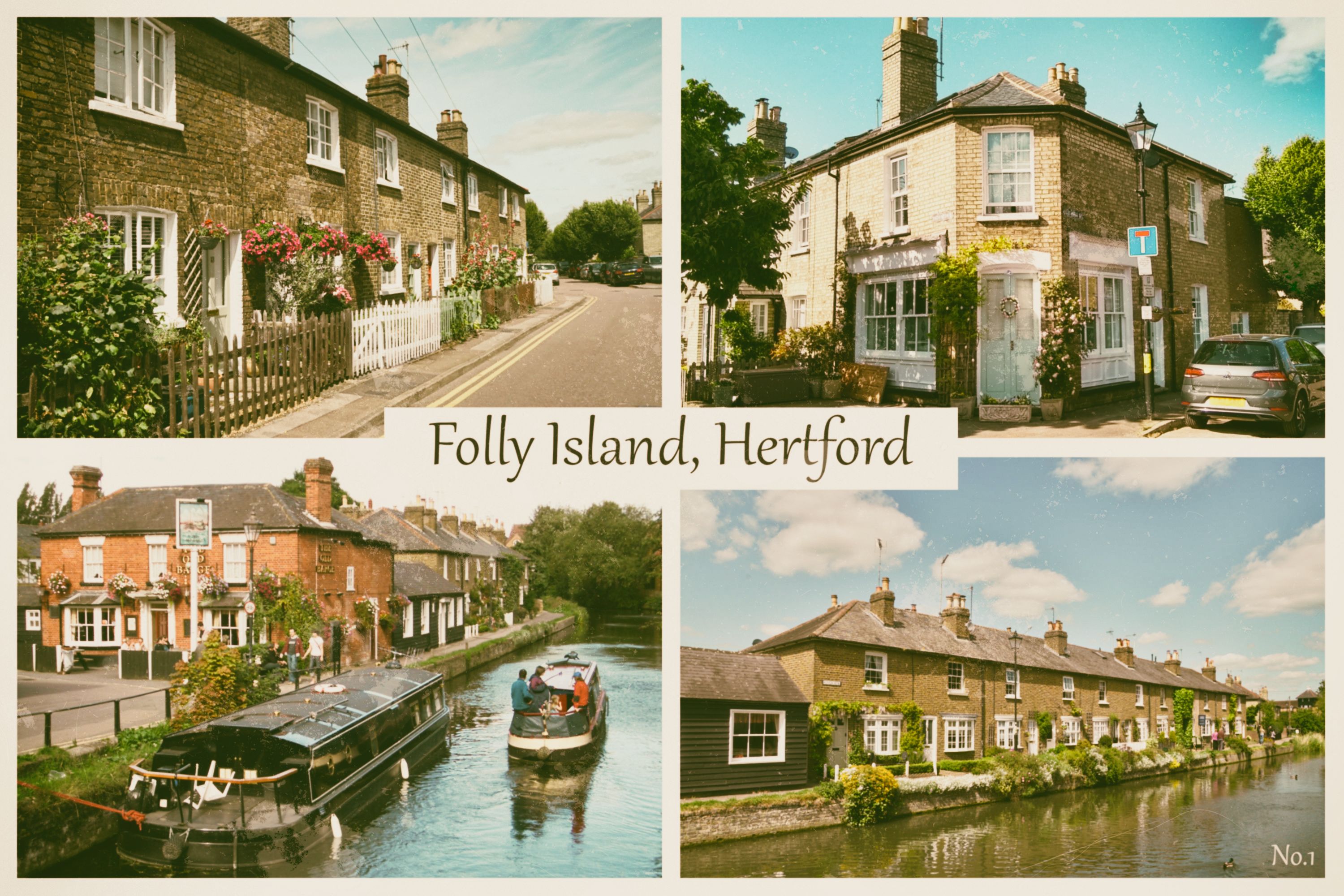
Folly Island

This was the first postcard I posted on social media. There is little to date any of the images, save maybe the car and streetsign top right. The number in the bottom right-hand corner was added later when I decided to create a series of fifty.

Hertford Castle

As with Folly Island above there is little in this handful of images to suggest when they were taken. This postcard is numbered 3 as the trial image of West Street was numbered 2.

Old Cross

No.4 in the series is four images of Old Cross, again with little to suggest how old the images are.

Pinehurst

The Pinehurst estate was built in the 1970s and is No.5 in the series. A MacDonalds and a community centre might be unlikely views to feature on a genuine postcard.

Bengeo

Formerly a village, now a locale of Hertford, the top right-hand picture of Port Hill, featuring contemporary cars might suggest that this postcard isn't as old as it might at first appear.

Hertford By Night

Four images of Hertford by night with little to date them. All of these were stock images from my library.

St.Andrew Street

A postcard of timeless images, only revealed by the presence of the Indian restaurant bottom right. Curiously both orange buildings are immediate neighbours to the church.

Churches

It's a complete fluke that No.8 and No.9 both have St.Andrew's church in the bottom left-hand corner. The ageing is a little more apparent in this postcard.

Blakemore

This postcard of Blakemore Manor estate should put to rest any questions about the authenticity of the series (or lack of). Whilst the woodland is ancient, the estate is still under construction.

Rivers

Hertford is known for being the confluence of four rivers - the Lee, Rib, Mimram and Beane. A lesser stream named the Ashbourne is also sometimes acknowledged.

Hertingfordbury

A village some 1km west of the town centre. Only the cars date the photos in this selection.

Gates of Hertford

This the first of the unusual themes. Finding a focus for 50 postcards is quite a challenge but it does give you the opportunity to pick out some more eccentric subjects. Working clockwise from top-left we have the gates of Hertford Castle, the original gates of All Saints Church, The Warren, and Hertford Brewery, although they are not the main gates.

Fore Street

Back to familiar territory for postcard no.14. A geographical theme featuring familiar scenes from one of the main town centre streets.

Foxholes

To the south-east of Hertford is an area known as Foxholes. Recent development has followed sand extraction, including the Foxholes estate, built in the late 1980s and early 1990s with over 800 homes built. A business park has also been established. Farming remains to the south.

Shopfronts

Hertford town centre features a large number of historic shopfronts. many of them fronting listed buildings and some dating back over a century.

Parliament Square

No.17 in the series features views of Parliament Square. Previously a roundabout, the area was pedestrianised in the 1990s. The centrepiece of the square is Hertford's war memorial.

Trees

Another unusual theme. I know very little about trees so I can't tell you what they are but they are notable trees in their appearance nonetheless.

Newland Gardens

Built in the opening years of the 21st century, this Barratt development replaced a large sprawling Addis factory. The architecture takes cue from the office buildings fronting Ware Road, which remain, although not part of the development.

Bridges

No.20 in the series focuses on bridges, clockwise from top left - Mill Bridge over the River Lea, the A10 viaduct taking the dual carriageway across The Meads, Folly Bridge and Cowbridge across the River Beane.

Schools

Four of Hertford's schools - in clockwise order, Richard Hale, Abel Smith, Duncombe and Sele School.

Horns Mill

Flats in Cecil Road, Mac's convenience store, homes in Brickendon Lane and Ginger Indian bar and restaurant in Horns Mill Road.

Sele Farm Estate

Shops in Fleming Crescent, new-build homes in Tudor Way, recently constructed housing at The Ridgeway and flats in Bentley Road. There is plenty in these views to identify them as contemporary.

Roundabouts

Here's where it gets a bit weird. I can't imagine anyone would believe there was a genuine postcard feauring roundabouts. Not the easiest of subjects to photograph. Top left is the Bluecoats roundabout in Hertford, which suffers serious congestion at peak times. To the right is Parliament Square, technically no longer a roundabout. Beneath that is the Rush Green interchange and to the left of thet, a small roundabout on Page Road.

Molewood

Four images of Molewood, included Great Mole Wood, the River Beane, the Molewood railway tunnel and former pumping station on the site of Molewood Mill.

West Street

West Street featured as the original proof of concept in this series of postcards but was never published. However, a production version was eventually created using two library images and two original shots. West Street is one of the most picturesque streets in Hertford and any number of images could have been used here, but alas we're limited to just four.

Hartham

Now past the halfway mark in the series of 50, we feature four images of Hartham Common (often wrongly referred to as Hartham Park). Top left is the "beach" on the River Beane, and to the right nearby footpaths. Bottom left is Hertford Tennis Club and to the right is the newly redeveloped leisure centre.

Clocks

Another of the "specialist" themes. Top left to right are the clock at Hertford Brewery and the clock atop Shire Hall. On the bottom row are the clock on the former Addis building in Ware Road, and the cock above the former dining hall of Christ's Hospital school.

Balls Park

Once one of the great houses of the town, the Balls Park Estate went from a country home to prestigeous housing development via a teacher training college and popular filming location.

Rooftops

This theme sprang from a larger project looking at the roofs and upper storeys of buildings in Hertford.

The Meads

Everyone knows The Meads, or King's Meads as they're often known. A large expanse of water meadow that stretches from Hertford to Ware, and bordered to the north by the River Lea. A viaduct carrying the A10 dual-carriageway across The Meads was opened in 1976.

Sport

It's by chance that all four sports featured here are ball games. I could have - possibly should have - included canoeing.

Public Transport

Another quirky theme, featuring the most prevalent forms of public transport in the town.

Hertford Market

The town's Charter Market has been much neglected in recent years, with the number of stalls diminishing. There is however a popular farmers' marke once a month.

Hertford In Bloom

A quartet of images featuring planting in Hertford and the town centre "in bloom".

Panshanger Park

Panshanger Park is a 1000 acre country park and nature reserve to the west of Hertford. Once the estate of Earl Cowper, it was landscaped in the early 19th century with advice from Humphry Repton. Following the death of the 7th Earl Cowper in 1905, the estate was inherited by Ethel Grenfell, Baroness Desborough and, after she died in 1952 with no heir, the estate was sold and the mansion demolished. The park contains the largest maiden oak in the country, with a circumference of 7.6 metres. It is believed to have been planted by Queen Elizabeth I. (Wikipedia)

Culture

There is much in Hertford to celebrate in the way of the arts and this is represented in No.36 in the series.

County Hall

Four images of County Hall in Hertford, little used following the relocation of staff and implementation of working from home.

Abandoned Hertford

No.38 in the series features a mix of contemporary and lost scenes. Top left is the former British School in Dimsdale Street, awaiting a new purpose. Top right is the old electric works, demolished in the early 2000s to make way for housing. Bottom left is buildings that former part of the old Hertford County Hospital, now gone; and bottom right is a sadly neglected shop in St.Andrew Street that will hopefully one day find a new use.

Growing Hertford

Four panels showing types of growth in Hertford. The building of a new industrial estate at the top of Caxton Hill, Gage Gardens on the new residential estate of Blakemore Manor, the new theatre and cinema at BEAM Hertford in The Wash, and new trains at Hertford East Station.

Winter

Four snowscenes - The River Lee, St.Leonard's Church, the Postern Gate at Hertford Castle and the war memorial in Parliament Square.

Statues

Top left: Sam Stone, funder of Hartford in Connecticut. Top Right: A Bluecoat Boy outside the former Christ's Hospital School. Bottom left: A stag atop the war memorial in Parliament Square. Bottom right: Mercury, the Roman God of messages and communication, in front of the former headquarters of local newspaper The Hertfordshire Mercury.

Post boxes

Included in this selection of postboxes is Hertford's oldest post box in Ware Road, over a century old.

Farming

Four photos showing arable and livestock farming in the fields around Hertford.

This article was first published on 12th April 2024
and last updated on 19th February 2025